


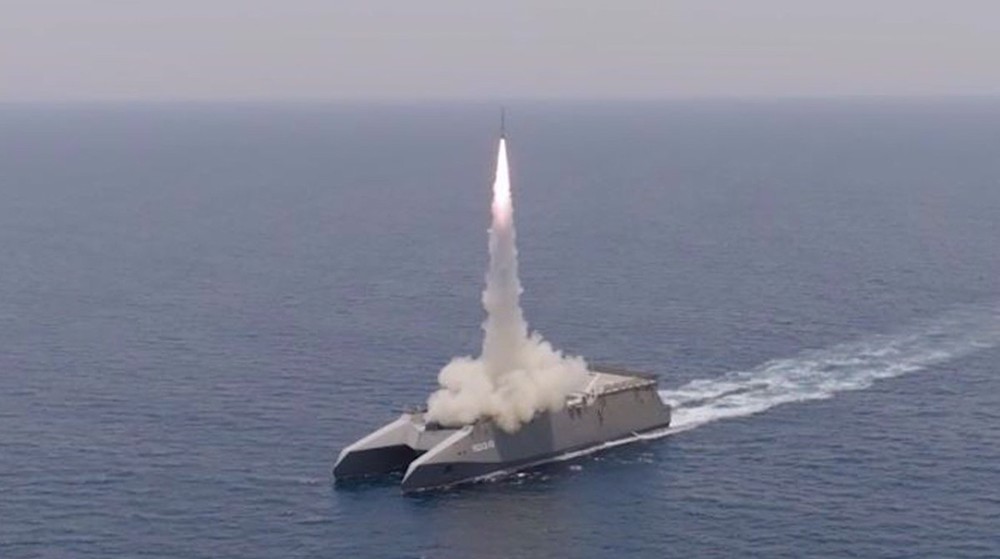
The Islamic Revolution Guards Corps (IRGC) Navy has successfully launched the Sayyad-3G naval air defense missile for the first time during the “Smart Control” exercises in the Strait of Hormuz.
According to footage released during the drills on Saturday, the missile was fired from the vessel Shahid Sayyad Shirazi, marking the system’s operational debut at sea.
The Sayyad-3G is the naval variant of Iran’s Sayyad-3 air defense missile and features a vertical launch system with a reported range of 150 kilometers (93 miles).
Iranian officials said the missile offers medium-to-long-range air defense coverage and facilitates the establishment of a regional air defense umbrella for vessels of the Shahid Soleimani class.
Authorities stated that the system is capable of independently detecting and engaging aerial threats, while also being integrated into a broader command-and-control network. This dual capability, they said, enhances the survivability of naval units against a range of air threats.....more below
US Army Secretary Dan Driscoll is preparing to leave the Trump administration after what a new report has described as months of tension with Secretary of War Pete Hegseth, potentially triggering another change at the army’s top echelons.
According to the Friday report by The Wall Street Journal, Driscoll is expected to step down before the end of the year and could leave his post earlier. The newspaper cited people familiar with discussions over his departure.
The Journal reported that Driscoll and his family vacated the official residence assigned to the army secretary at Joint Base Myer-Henderson Hall this summer, a move that could indicate he was preparing to leave the position.
The reported departure would come at a time of continuing uncertainty at the top echelons of the army.
Hegseth abruptly removed Army Chief of Staff Gen. Randy George in April, while Trump has not yet nominated a permanent successo....more below
...

The Islamic Revolution Guards Corps (IRGC) warns the enemies that any act of aggression against the Islamic Republic will not go unanswered.
In a statement on Thursday, the IRGC issued a “stern warning” to the enemies after US forces launched strikes against the southern Iranian port city of Bandar Abbas.
Following the US military attack on a point on the outskirts of Bandar Abbas Airport with aerial projectiles, the IRGC carried out new strikes targeting the US air base from which the attack originated in the wee hours of Thursday, it added.
“This response is a serious warning to the enemy that they should know the act of aggression will not go unanswered,” the IRGC emphasized.
The elite military force warned of a “more decisive” response if the enemy repeated any act of aggression.
It also said the responsibility for the consequences of any IRGC response lies with the aggressor.
The statement comes after the IRGC Navy on Thursday forced an American tanker to turn back. The tanker ...